
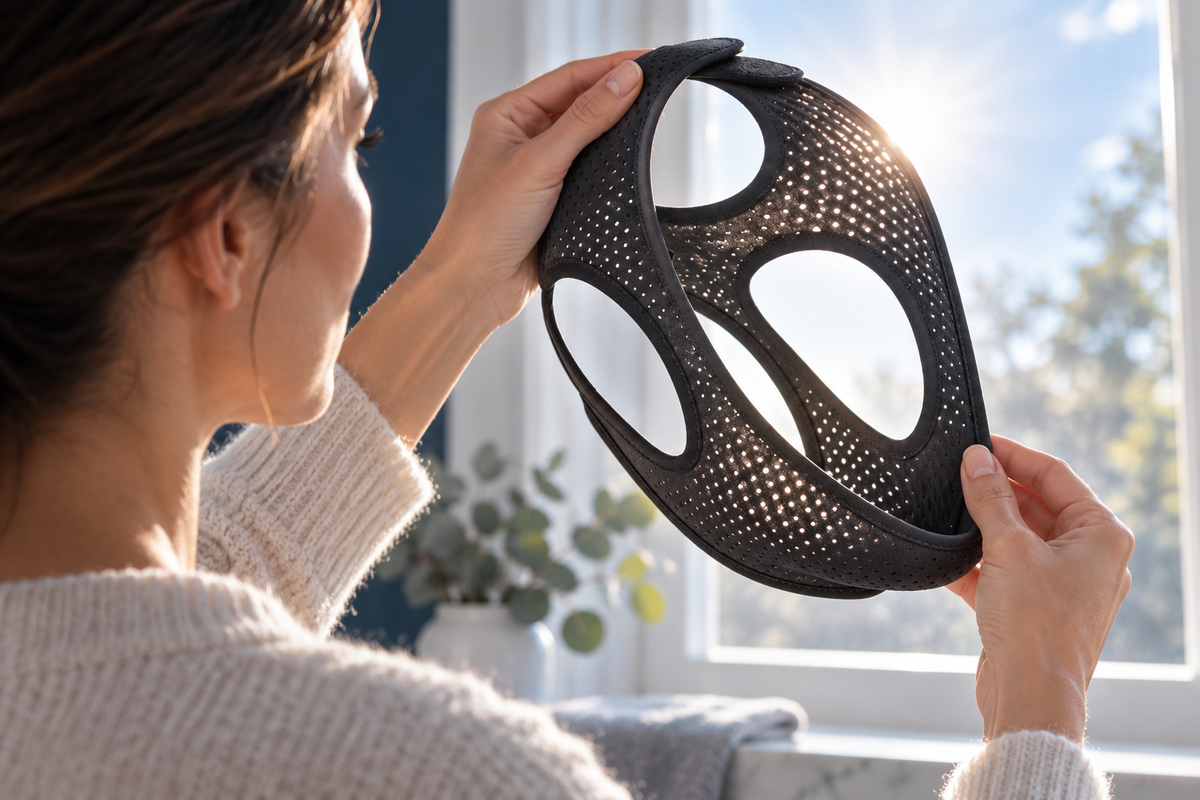
A brief visual check before reusing a chin strap can help you notice an obvious handling issue. It is a simple product check, not a substitute for the supplied fitting or care instructions.
Look at the main parts
Open the strap in good light and identify the broad chin cradle, ear openings, fabric edges, and fastening. Notice anything caught in the closure or any panel twisted during storage.
Check whether the item is ready for use according to its care guidance. Do not assume that a strap is clean, dry, or undamaged simply because it was put away in its usual place.
Compare with what you expect
If an edge appears torn or a fastening looks different, pause before wearing it. A clear product photo and order reference can help support understand the issue.
Avoid testing damaged fabric by stretching it hard or using sharp objects around the perforations. Do not repair the strap with glue, pins, or tape to make it through another evening.
Check comfort again during setup
Fit the strap while awake according to the directions, keeping your nose and mouth uncovered. Remove it if uncomfortable. A product that looked intact on a table can still have an unsuitable fit for you.
Contact RestHaven when a repeated issue needs clarification. During the 30 night trial, you can also decide to return the accessory. The free return process begins with an email and order verification, followed by a prepaid label or carrier barcode.
Follow the shape instead of scanning the whole item at once
A quick inspection becomes more useful when it follows a consistent route. Place the strap where you can see it clearly, identify the chin cradle, and then follow the side panels toward the ear openings and crown fastening. This makes a twisted section or caught edge easier to notice.
Look at the current item rather than trying to recall exactly how it appeared in a campaign photo. Product photography is arranged for visibility and style; your check concerns the actual fabric, seams, and closure in front of you. Open the shape gently without stretching one area to imitate an image.
If you notice a change, describe it precisely. An edge that appears rough or a fastening that no longer joins as expected gives support a useful starting point. Avoid assigning a technical cause or trying a repair before the issue has been understood.
How long should an inspection take?
There is no need to invent a timed ritual. The purpose is to see the important parts in adequate light and resolve obvious twists or uncertainties before fitting. A rushed glance in a dark room may miss the very detail you intended to check, regardless of how quickly it is completed.
What if the item looks normal but feels uncomfortable?
Appearance does not settle a comfort question. Remove the strap if it causes pain, irritation, breathing difficulty, or persistent pressure, and reassess using the supplied instructions. A clear visual check is one practical step, not a guarantee that the product suits every person or every situation. Contact support about product questions and a clinician about medical suitability.
Treat the supplied instructions as the starting point
Product care begins with the directions for the exact item you own. Two accessories can look similar while using different materials, coatings, stitching, or fastenings. A cleaning method that worked for another product is not automatically appropriate for a RestHaven strap.
Read the instructions before the first cleaning, not after deciding which method seems convenient. Look for the permitted cleaning process, drying guidance, and any restrictions. Keep the information with the order details so you can find it again without searching through unrelated packaging.
If the instructions are missing, incomplete, or difficult to interpret, contact support@shopresthaven.com. Identify the item and the particular step you need clarified. It is better to resolve an uncertainty than to guess at a detergent, temperature, machine setting, or drying method.
This guide intentionally does not invent a universal wash recipe. Product photographs show appearance, not care compatibility. The visible perforations and black fabric should not be used to infer an unconfirmed fiber blend or to assume that a household disinfectant will be suitable.
Inspect the item before deciding what it needs
Place the strap on a clean surface with enough light to see the edges and fastening. Follow the shape from the broad chin cradle toward the ear openings and crown. Check whether the fabric is twisted, folded, or caught on another object before assessing its condition.
Look for visible changes rather than trying to assign a lifespan from appearance alone. A rough edge, loose stitching, or fastening that behaves differently may be worth asking about. Do not declare an item safe or unusable solely because it resembles an example from an unrelated product.
Separate ordinary storage folds from a problem you do not understand. Open the product gently and compare its shape with the instructions. Avoid pulling hard on a specific area to restore a display pose or force the strap to match a campaign photograph.
If there is damage or uncertainty that affects use, pause and contact the team. A clear description of the part involved is useful. If you choose to send a photo, keep the frame focused on the item and exclude private information from nearby labels or paperwork.
Handle the fastening deliberately
The crown closure is an important part of the adjustable design. Open and close it in accordance with the supplied directions rather than pulling the entire strap apart from whichever edge is easiest to reach. Careful handling also makes it easier to notice when something changes.
Keep the fastening away from delicate clothing and other materials that may catch on it. When storing or packing the strap, arrange the closure as directed for the item. Do not leave it tangled with unrelated hook and loop fastenings in a bag.
If lint or debris is visible, do not immediately use a sharp tool, solvent, or aggressive scraping method. Check the approved care guidance first. Removing an obstruction in a way that damages the joining surface can create a different problem from the one you were trying to solve.
If the closure no longer secures as expected, avoid adding glue, tape, pins, or an extra band. Those changes alter the product. Ask about the issue and the available options instead of improvising a repair that changes how the strap is held in place.
Separate cleaning, drying, and storage
These are three related steps, but each deserves attention. A permitted cleaning process does not automatically tell you that a particular drying method is allowed. Likewise, a convenient storage container may be unsuitable for an item that has not fully dried.
Follow the supplied instructions throughout the sequence. Do not speed up drying with unapproved heat because you want to use or pack the strap immediately. If timing is inconvenient, adjust the plan rather than inventing a method for the material.
Before enclosing the item, check that it is fully dry. Choose a clean storage place where other objects will not crush the shape or catch the fabric. Keep it away from laundry and from toiletries that could leak onto it.
A spare may make the routine more convenient, but it does not replace proper care of the first item. Decide whether an additional strap has a real use before buying it. The aim is a manageable personal routine, not a growing collection of items whose condition you cannot track.
Create storage that supports the next use
Choose a location you can recognize easily. A clear personal area is often more useful than a hidden container shared with many unrelated objects. You should be able to take the strap out, inspect it, and return it without reorganizing the whole surface.
Avoid placing heavy books or sharp accessories on top of the fabric. Protect the openings and bound edges from snagging surfaces. If the item is packed for travel, use a suitable arrangement that keeps it separate from shoes, laundry, and liquids.
Do not assume that a decorative pouch, box, or tray in an editorial photograph is part of the order. Use the listing to confirm what is included. You may already own a suitable storage option and do not need to purchase something new merely to recreate the image.
If two people use straps, give each item its own place. Separate storage locations can prevent confusion without marking or modifying the product. Each person's care and fit decisions remain personal even when the straps were purchased in the same pack.
Keep a useful record of a change
If something looks different, note when you first noticed it and which part is involved. Describe the visible detail without guessing at a technical cause. A statement about an edge or closure is easier for support to understand than a broad claim that the whole product has changed.
Mention the care process you followed using the instructions available to you. Do not hide a relevant detail because you are worried about how the question will be received. A clear account helps the team understand the item and explain the appropriate next step.
Keep the original instructions and the support reply together. If the team clarifies a step, you will be able to find that clarification next time. Avoid keeping several contradictory personal notes that make it difficult to identify the current guidance.
Do not send unnecessary sensitive information. Passwords, complete card numbers, bank logins, and detailed medical histories are not needed for a normal product care question. The order number and checkout email can help identify the purchase when that is relevant.
Check fit again after handling or travel
Before reuse, confirm that the product is oriented correctly and that the fabric is not twisted. Follow the supplied fitting directions rather than assuming the strap is ready simply because it was comfortable in a previous arrangement.
Make an awake check with the nose and lips uncovered. Notice the position of the chin cradle, side panels, and ear openings. If an edge is folded or a closure has not aligned as intended, release the product and reassess it rather than increasing tension automatically.
Remove the strap if it causes pain, irritation, breathing difficulty, or persistent uncomfortable pressure. A care routine should not become a reason to continue wearing a product that now feels unsuitable. Medical suitability and use with prescribed equipment should be discussed with the appropriate clinician.
If you cannot tell whether a problem concerns care, condition, or fit, describe the current observation to support. You do not need to solve the technical cause before asking for help. Avoid cutting, sewing, or attaching another material to force a result.
Understand how care questions relate to the trial
RestHaven's 30 night trial allows a free return request within 30 days of delivery. Normal trial use does not by itself make the purchase ineligible. The returns page explains how to begin the process and what information the team needs.
Email support@shopresthaven.com with the order number, checkout email, and the item or pack involved. The team verifies the request and sends a prepaid return label or carrier barcode. Follow those instructions rather than choosing a carrier or return address independently.
For a complete pack return, include every strap from that pack. If you want to return only part of a pack, confirm the items and refund amount with support before sending the parcel. Keep the drop off receipt and tracking reference until the return is resolved.
After receipt, the team checks the parcel against the request and issues the refund for the returned items to the original payment method. Your provider may need additional time to display the credit. Clear care information and an accessible return route both support the same aim: an informed decision about the product you own.
Put the information to work
Choose the one question from this guide that matters most to your situation and write down the next action it calls for. That might mean checking the supplied instructions, reviewing an order detail, asking the team a specific question, or deciding that you need more information before purchasing. You do not need to complete every possible step at once.
Keep the relevant product information and any support reply together so you can find them when needed. Use the current RestHaven product page for the available pack options and prices, and the returns page for the 30 night trial process. The team can be reached at support@shopresthaven.com.
For a related practical question, continue with Look After the Hook and Loop Fastening. Each guide can be read independently; use the contents links to return to the section that answers your immediate question.