
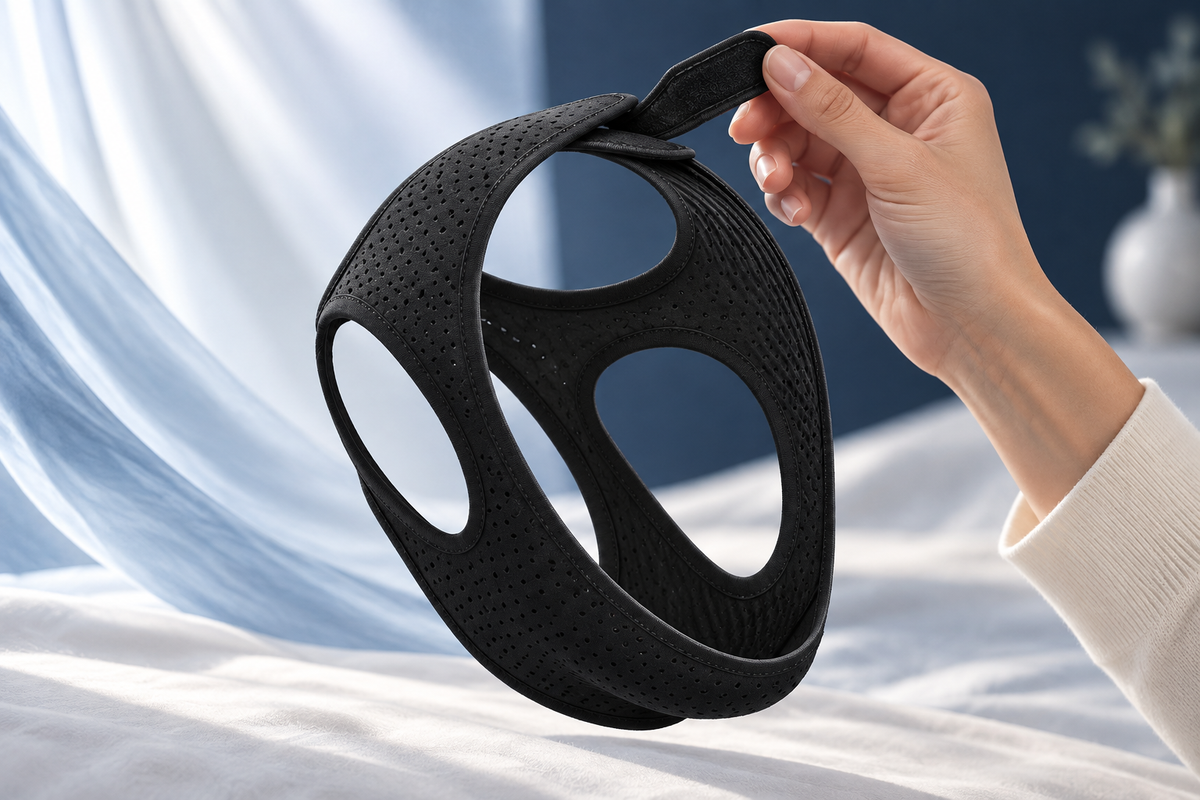
An adjustable chin strap offers a way to change its fastening position. It does not mean that a tighter setting is more effective, more premium, or more appropriate for your needs.
Separate support from pressure
Begin with correct placement according to the supplied directions. Check the cradle, the ear openings, and any twisted fabric before changing the closure. Tightening a misplaced strap can make the placement problem harder to recognize.
Judge the setup while awake. If you notice uncomfortable pressure or difficulty breathing, remove the strap. Do not interpret discomfort as evidence that the product is working.
Avoid a tightening routine
It is easy to respond to every small movement by pulling the closure a little further. Pause instead and ask what actually changed. Did an edge fold? Was the cradle off center? Does the overall size seem unsuitable?
There is no published RestHaven tension target in this guide, and a lifestyle image cannot supply one. Do not copy an imagined setting from a model or use a ruler to invent a tightening requirement.
Ask for clarification when needed
Contact support if you cannot identify a comfortable setup using the supplied instructions. Describe where you feel pressure and what you have already checked.
The trial is a chance to assess an accessory, not a challenge to tolerate it. A free return request within 30 days of delivery is available if the fit does not work for you. Medical questions about jaw support or breathing should be discussed with a qualified professional.
Notice the difference between adjusting and escalating
Adjustment is a deliberate response to a specific setup question. Escalation is pulling more tightly because the previous attempt did not deliver the feeling or result you hoped for. The two can look similar, so pause and ask what problem you are actually trying to address.
If the ear opening is misplaced, release and reposition the strap according to the instructions. If the fabric is twisted, straighten it while open. If the product feels unsuitable despite correct orientation, more tension is not automatically the missing step.
Avoid using a model photograph as a pressure guide. The image shows an arrangement, not the sensation beneath the fabric. You cannot infer a suitable fastening setting for your own head by judging how smooth the product appears on somebody else.
What should change after an adjustment?
You should be able to describe the specific difference you intended, such as correcting a fold or clarifying the closure alignment. If you cannot explain what you changed or why, stop and review the instructions instead of repeating the same action more forcefully.
What if the strap only stays in place when it feels uncomfortable?
Remove it and ask about the fit. Do not accept persistent pressure, pain, irritation, or breathing difficulty as the price of keeping the product positioned. A design may simply be unsuitable for an individual. The trial return process gives you a practical alternative to forcing a result, and support can explain that process without asking you to keep tightening a setup that does not feel right.
Give comfort a more useful definition
Comfort is not a single visual setting that can be copied from a photograph. For a wearable accessory, it includes the feel of the material, the position of the edges, the ease of making an adjustment, and your ability to stop using it when something does not suit you.
Begin by deciding what you want to notice. An edge that rolls inward is a different observation from a fastening that feels awkward to reach. A product that seems unfamiliar is a different description from one that causes pain. Clear language helps you make a decision without treating every sensation as the same problem.
There is no requirement to endure discomfort to justify a purchase. The 30 night trial provides time to decide, not a target for how long you must keep trying. If the product does not suit you, that is useful information about your experience with this particular design.
Avoid comparing your tolerance with another person's. A partner may prefer a different adjustment, have different facial hair, or notice the fabric differently. Their experience can be interesting, but it is not a standard that your own comfort must meet.
Look at the surfaces that actually touch you
RestHaven's black perforated fabric has visible openings and bound edges. A close product photograph can show those construction details. It cannot tell you exactly how the material will feel against your skin, and it should not be used to invent an unconfirmed fabric composition or allergy claim.
During an awake check, notice where each edge lies. Look for a fold, an uneven side panel, or hair caught near the fastening. A small visible obstruction may help explain why the setup feels different on one side, but do not assume every uncomfortable sensation can be solved by repositioning.
The openings around the ears should be checked as part of the whole arrangement. If one opening seems misplaced, release the strap and reset the fabric according to the instructions. Pulling a fastened edge harder can change several parts of the setup at once and make the problem less clear.
Do not cut the material, trim an opening, add padding, or sew a new closure to force a fit. Those changes alter the product. Ask about the design or return route instead of turning a trial into a project to rebuild an accessory that may simply be unsuitable.
Separate a positioning check from a pressure change
Before adjusting the crown, identify the chin cradle and the route of the side panels. Check that the product is oriented correctly and that no part is twisted. The easiest time to correct the basic shape is while the strap is open and off your face.
Place it following the supplied instructions, keeping the nose and lips uncovered. Make a gentle initial adjustment, then consider the entire fit again. A mirror can show an edge that needs attention, while your own description tells you how the setup feels.
More tension is not automatically a better result. An adjustable closure is a way to find an appropriate setup within the design, not an invitation to pull as far as possible. If you find yourself tightening repeatedly without resolving the problem, stop and reconsider the fit.
Remove the strap if you experience pain, irritation, restricted breathing, or persistent uncomfortable pressure. Do not sleep in a setup that already feels wrong while you are awake. For medical suitability or use with prescribed equipment, seek advice from the clinician responsible for your care.
Introduce one change at a time
A simple introduction is easier to assess than a complete bedroom makeover. If you change the strap adjustment, pillow, room layout, and bedtime schedule all together, you may find it difficult to describe which part of the experience you are actually evaluating.
Choose a convenient moment while fully awake, keep the instructions available, and focus on understanding the accessory first. You do not need a perfect evening or an elaborate ritual to ask whether the fastening is manageable and the shape feels suitable.
If you are checking contact with your usual pillow, remain awake and able to remove the product. Notice whether the fabric folds or an edge shifts in that position. Do not create a stack of extra accessories to hold an uncomfortable setup in place.
When you change something in accordance with the instructions, make the change deliberately and check again. If the product continues to feel unsuitable, more repeated trials are not automatically more informative. A clear question to support or a return may be the more useful next step.
Make a short note only when it helps
You can record a few words about the feature you were assessing. For example, note whether the left edge was folded, whether the crown closure was easy to reach, or whether you were unsure about the intended position. These details are more useful than a vague rating with no explanation.
Keep observations separate from conclusions. Saying that the fastening was difficult to align describes an experience. Saying that the product must work differently for everyone because of that one experience goes beyond what the note establishes. The same distinction applies when describing a positive experience.
A note can help you avoid repeating the same unclear adjustment, but it should not become another obligation. If writing it down makes the evening more complicated, a brief message to support may be sufficient. The purpose is clarity, not a detailed record for its own sake.
Never use a chart to talk yourself out of stopping when something feels wrong. A record that leads to a decision to return the product has served its purpose just as much as a record that helps you ask a more precise question.
Protect personal boundaries during a shared trial
If you share a bedroom, agree that the person wearing the strap controls its use and adjustment. A partner can observe a visible twist, help read a label, or remind you where the instructions are. They should not insist on a tighter setting or continued wear against your preference.
Discuss practical feedback at a time when neither person is trying to fall asleep. Ask what felt straightforward and what remained uncertain. A short conversation after breakfast may be easier than turning the final minutes of the evening into a review meeting.
Each person should have their own item if both choose to use a strap. Separate use also means separate fit decisions. A pair pack can make purchasing more convenient, but it does not mean the same setting or experience applies to both people.
Keep personal photos optional. You can ask a fitting question in writing first. If you choose to send a photograph, focus on the product detail and exclude unrelated private information from the frame. An image is a communication aid, not a requirement to prove that you deserve assistance.
Care for the item using confirmed instructions
Read the directions supplied with the strap before cleaning it. A photograph cannot establish whether a material tolerates a particular detergent, temperature, machine cycle, dryer, or disinfectant. Do not borrow a care method from another accessory merely because the two items look similar.
If the instructions are missing or unclear, contact support before experimenting. Keep the product separate from sharp objects, open fastenings on other items, and surfaces that could catch the fabric. A clean, dry, accessible storage place makes it easier to inspect the item before use.
Allow the strap to dry fully after any permitted cleaning before putting it into enclosed storage. Do not use heat to speed the process unless the product directions explicitly permit it. A spare can be convenient, but it is not a reason to invent a care method for the first item.
Check for visible changes before reusing the strap. If the closure no longer behaves as expected or an edge appears damaged, pause and ask about the issue. Avoid making a repair that changes the shape just to preserve a routine you have already started.
Keep the return route simple
The RestHaven trial allows a free return request within 30 days of delivery. Normal trial use does not by itself make the purchase ineligible. Keep your order confirmation and delivery date available so that the team can identify the purchase easily.
Email support@shopresthaven.com with the order number, checkout email, and the item or pack you wish to return. The team verifies the request and sends a prepaid return label or carrier barcode with instructions. Use that process rather than sending the parcel to an address you found elsewhere.
For a complete pack return, include all straps from the pack. If returning only part of a pack, agree on the items and refund amount with support before posting it. Use suitable protective packaging and keep the drop off receipt and tracking reference.
After receipt, the team checks the returned parcel and issues the refund for the returned items to the original payment method. Your bank or payment provider may need additional time to display it. Comfort remains a personal decision, and the process should leave you free to make that decision honestly.
Put the information to work
Choose the one question from this guide that matters most to your situation and write down the next action it calls for. That might mean checking the supplied instructions, reviewing an order detail, asking the team a specific question, or deciding that you need more information before purchasing. You do not need to complete every possible step at once.
Keep the relevant product information and any support reply together so you can find them when needed. Use the current RestHaven product page for the available pack options and prices, and the returns page for the 30 night trial process. The team can be reached at support@shopresthaven.com.
For a related practical question, continue with Keeping Lips and Nose Uncovered During Fitting. Each guide can be read independently; use the contents links to return to the section that answers your immediate question.