
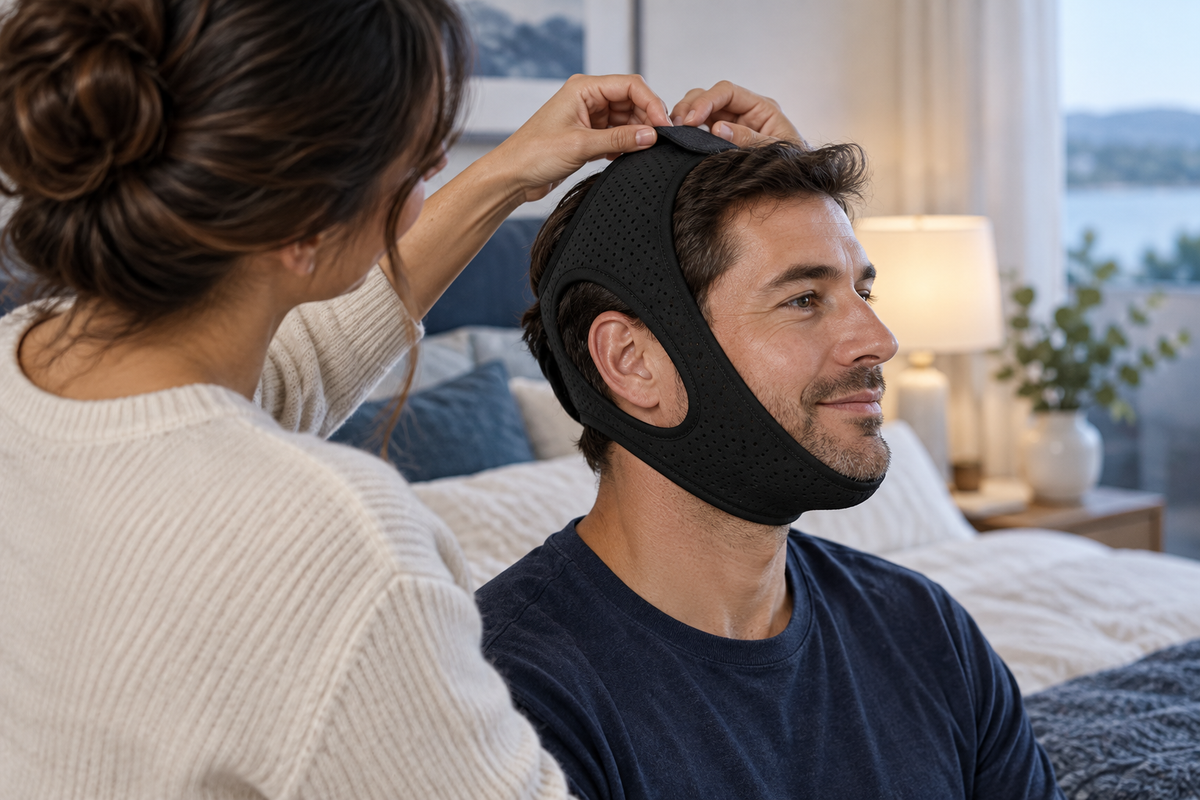
A partner can help you see a chin strap from an angle that is awkward in a mirror. Keep that help gentle and optional, with the wearer in control of every adjustment.
Ask before touching the fastening
The person wearing the strap should read the supplied instructions and position it while awake. A partner can then describe what they see, such as a folded edge or an ear opening that looks uneven.
Offer an observation before reaching in to change anything. “That edge looks folded” is more useful than silently pulling the closure tighter. The wearer is the person who can describe pressure and comfort.
Use a simple visual check
Look at the broad chin cradle, side panels, and crown fastening. Make sure the lips and nose remain uncovered. If something is misplaced, the wearer can open the strap and reset it according to the directions.
Do not add ties, tape, or improvised adjustments. If the product will not sit comfortably, stop and contact support rather than treating a second pair of hands as a way to force it into place.
Respect the wearer's decision
Your partner may decide that the fit is not for them, even if it looks neat to you. A comfortable experience matters more than a tidy photograph or a shared expectation about the purchase.
The 30 night trial provides a free return route if needed. Helping with a fit check should make that decision easier, without creating pressure to keep the product.
Be a second pair of eyes, not a second set of controls
Imagine your partner asks whether the fabric near one ear looks folded. The most useful answer is a description of what you can see. Reaching over and tightening the crown without warning changes the setup before the wearer can connect your observation with the sensation.
Ask before touching the strap. Often the wearer can release and reposition it themselves once the visible detail has been explained. Keep the supplied instructions available so that both people are referring to the same product information rather than inventing an adjustment together.
The wearer should remain in control of stopping. If they describe pain, irritation, breathing difficulty, or persistent uncomfortable pressure, encourage removal rather than insisting that the product looks fine. A partner's visual impression does not determine another person's comfort.
What language makes help clearer?
Name the part: chin cradle, side panel, ear opening, or crown fastening. Describe the visible issue without adding an unsupported explanation. A precise statement about a fold is easier to act on than a general judgment that the whole strap needs to be tighter.
What if neither of you understands the instruction?
Pause and ask support the specific question. You do not need to solve it by trial and error before contacting the team. Medical suitability belongs with an appropriate clinician, while product support can clarify available design information. Helping your partner includes respecting a decision to wait, stop, or use the trial return route if the item does not suit them.
Choose a conversation that leaves room for both people
A shared bedroom contains two people's preferences, routines, and limits. Before discussing a new accessory, agree that the conversation is about finding a workable evening together. It should not become a judgment about which person is responsible for making every night ideal.
Choose a time when neither person is trying to sleep, rushing out, or already annoyed. The timing does not need to be formal. A short, calm conversation is often easier to follow than a long discussion held at the end of a tiring day.
Begin with your own experience and a concrete observation. Describe what you noticed or what practical change would help your routine. Avoid making a diagnosis, assigning motives, or treating a product purchase as proof that someone cares about the relationship.
Give the other person an opportunity to answer without immediately proposing a solution. They may have a different concern, such as discomfort with a wearable accessory, confusion about sizing, or uncertainty about whether medical advice is needed. Those are useful facts for the decision, not obstacles to overcome.
Separate the shared plan from the individual's choice
You can plan the room together while leaving use of the strap to the individual. Decisions about where to store a book, which lamp to switch off, or how to keep the bedside surface clear are shared practical matters. The decision to wear an accessory belongs to the person wearing it.
An offer to help should make the choice easier, not create pressure. Ask whether your partner wants a second pair of eyes during a fit check or would prefer to work through the supplied instructions privately. Accept either answer without turning it into a test of cooperation.
The wearer should control the fastening and decide whether the product feels suitable. A partner may notice a visible fold or an ear opening that appears out of position, but appearance cannot establish comfort. Do not override a report of discomfort because the setup looks tidy.
If both adults choose to use straps, make separate fit decisions and keep the items personal. Buying a pair pack does not mean that both people should use the same adjustment, begin on the same evening, or reach the same conclusion during the trial.
Build a small plan you can actually repeat
Choose one or two practical actions for the evening. You might set phones in an agreed place, keep the product instructions beside a chair for an awake fit check, or clear a small area on each bedside table. The plan should reduce decisions rather than add a long list of tasks.
Different schedules do not automatically require identical routines. One person may read while the other gets ready for bed. Discuss lighting, noise, and access to belongings so that neither person needs to rearrange the room at the last moment.
Keep the plan flexible enough for ordinary life. A late meal, travel day, or busy morning does not mean the whole routine has failed. Decide which part is genuinely useful and which part can be skipped without creating friction between you.
Avoid buying more objects before you know what problem they solve. A shelf you already have may provide a useful storage spot. An existing notebook may be enough for a short reminder. A considered routine is defined by how it works for the two people using it, not by the number of products on display.
Offer fit help in a specific and respectful way
Start with the instructions supplied with the strap. RestHaven's visible features include a broad chin cradle, open ear spaces, perforated fabric, and a crown fastening. Knowing the names of those parts makes it easier to describe what you see without reaching over and changing the setup unexpectedly.
Ask permission before touching the strap while someone is wearing it. Often a verbal observation is enough: the fabric appears folded near the left ear, or the closure looks different from the diagram. Let the wearer release and reposition the product themselves where possible.
Keep the first fitting fully awake and unhurried. The nose and lips should remain uncovered. If there is pain, irritation, restricted breathing, or persistent uncomfortable pressure, the wearer should remove the strap. It is not helpful to encourage endurance as a way of making the purchase worthwhile.
Support can clarify product details and return steps. Questions about medical suitability or use with prescribed sleep equipment belong with an appropriate clinician. Caring about a partner includes recognizing when a retail accessory is not the answer to the question being asked.
Give feedback that someone can use
Useful feedback is specific, limited, and open to correction. Saying that the setup took longer than expected describes a practical issue. Saying that your partner always makes bedtime difficult turns a solvable detail into a judgment about the person.
Ask what kind of feedback is welcome. The wearer may want help remembering which fit question to send to support, but may not want a discussion of every small movement they made. Agreeing on the scope keeps observation from becoming supervision.
Do not turn one evening into proof of a product result. Personal experience can vary, and an observation from a partner is not a clinical assessment. A relaxed campaign photograph likewise should not become the standard against which your own relationship or bedtime is measured.
If you disagree, return to the practical decision. Does the person want to ask a question, pause, keep considering the product, or request a return? You do not need complete agreement about every detail to respect an individual's choice about what they wear.
Make space for two sets of belongings
Give each person a clear place for their own essentials. It can be a separate tray, a side of the table, or a shelf that is easy to reach. The exact furniture matters less than avoiding a setup where one person must move the other's belongings every evening.
Keep clean personal items apart from laundry and from anything that could catch the fabric. If two straps are in the room, agree on a simple way to distinguish them without modifying the product. Separate storage locations may be enough.
Consider the actions you actually perform: reaching for the lamp, taking off glasses, setting down a book, and finding the instructions. Place frequently used items where those actions are straightforward. Keep routes around the bed clear and follow the instructions for electrical items rather than improvising cable arrangements.
Leave some empty surface. It makes the area easier to use and helps you notice when an item is missing. You do not need a photographically perfect bedroom; a room that both people understand is often more practical than a display neither wants to disturb.
Handle gifting and buying without creating an obligation
A chin strap is a personal item, so discuss interest before choosing it as a gift. A surprise can feel different when the recipient interprets it as criticism of a nighttime habit. Asking first gives them room to decide whether the product is something they actually want to consider.
Explain the design and the trial without making promises on the product's behalf. Do not tell someone that it will fix their sleep, change their health, or make the relationship easier. A gift can offer a choice; it should not arrive with a required outcome attached.
If buying a multiple strap pack, count the intended users and any genuine need for a spare. A lower price per item does not make an unwanted second strap useful. Review the selected pack and cart quantity together so the order reflects what you agreed to buy.
Keep the order details available to the person who may need them. If the purchaser and wearer are different people, discuss who will contact support about a return. Share the relevant order information privately rather than posting it in a review or public comment.
Let the trial end with an honest decision
The 30 night trial gives time to decide whether the product fits the wearer's routine. A free return can be requested within 30 days of delivery, and normal trial use does not by itself make the purchase ineligible. Read the return terms together if that makes the process clearer.
To start a return, email support@shopresthaven.com with the order number, checkout email, and the item or pack involved. The team verifies the request and provides a prepaid label or carrier barcode. Wait for those instructions before sending the parcel.
A full pack return should include all straps from that pack. If only part of a pack is being returned, confirm the items and refund amount with support first. Keep the carrier receipt and tracking reference until the return has been received and the refund process is complete.
Whether the wearer keeps or returns the strap, acknowledge that they made a considered choice. The shared evening can continue to improve through practical conversation and respect for each person's preferences. An accessory should fit into that arrangement rather than become a measure of either person's effort.
Put the information to work
Choose the one question from this guide that matters most to your situation and write down the next action it calls for. That might mean checking the supplied instructions, reviewing an order detail, asking the team a specific question, or deciding that you need more information before purchasing. You do not need to complete every possible step at once.
Keep the relevant product information and any support reply together so you can find them when needed. Use the current RestHaven product page for the available pack options and prices, and the returns page for the 30 night trial process. The team can be reached at support@shopresthaven.com.
For a related practical question, continue with Making Room for Two People's Bedtime Essentials. Each guide can be read independently; use the contents links to return to the section that answers your immediate question.