
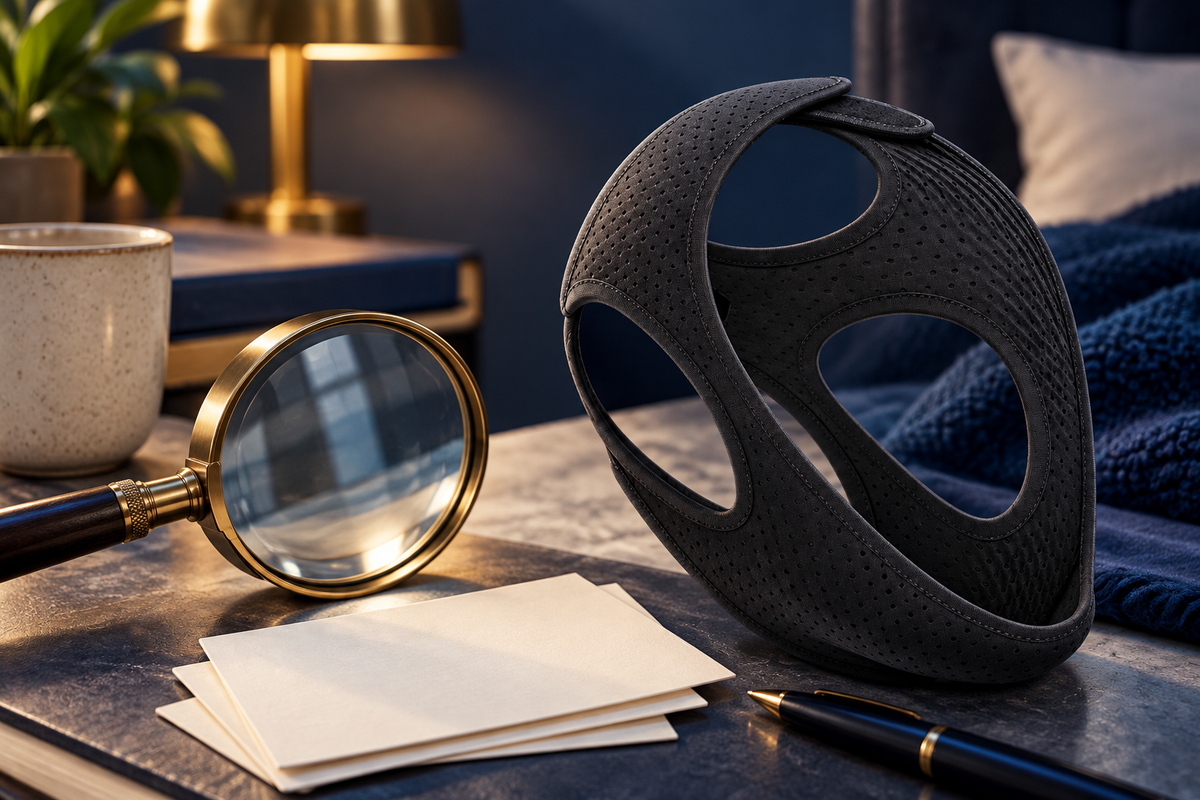
A convincing sleep product page can make a large promise feel ordinary. Pause long enough to identify exactly what is being claimed, what supports it, and whether it applies to the product you are considering.
Translate the headline into a question
If a page suggests an accessory works for everyone, ask how that statement was established. If it describes a material or fastening, look for a photograph that helps you inspect that detail. Construction claims and treatment claims should not be treated as equivalent.
Notice whether an image is a lifestyle scene, a customer supplied photo, or a documented comparison. Good lighting can make an accessory easier to see; it cannot establish that the product caused a change in someone's sleep.
Look beyond stars and badges
A rating is useful only when it relates to genuine experiences. Read what a reviewer actually describes and whether the context resembles your needs. A shield icon may communicate a return policy or checkout feature, but its shape alone does not mean medical certification.
Check the written policy behind a reassurance badge. What is the return window? Who provides the label? What happens after the item is received? Concrete answers help you judge the purchase without relying on urgency alone.
Apply the same standard to RestHaven
Inspect the adjustable closure and open ear design, read the size listing, and review the trial terms. Ask support for any missing product detail. If your question concerns diagnosis or treatment, take it to a healthcare professional.
A useful product decision is one you understand. You should be able to explain both why you are considering the accessory and what you do not expect it to do.
Match the strength of a claim to the evidence offered
Take a hypothetical advertisement with three statements: the closure is adjustable, the fabric has visible perforations, and everyone will experience a dramatic improvement. The first two describe features that can be inspected. The third makes a much broader promise and requires a different kind of support.
Make a habit of identifying the subject of the claim. Is it about the construction of the item, one person's experience, or an outcome for every buyer? A photograph may support a statement about a visible opening, but it does not prove an outcome across different people and circumstances.
Notice whether the claim supplies a source, a defined population, and a result that actually matches the wording. Do not assume that a study about a different device or a general discussion of sleep validates a specific retail product. If you cannot trace the claim to relevant evidence, leave it in the category of an unverified promise.
How should you interpret a review?
A genuine review can describe an individual's experience, but it should not be treated as a guarantee for another person. Consider what the reviewer actually observed, whether the review is about the same item, and whether its wording is being stretched into a broader claim. RestHaven does not use generated campaign portraits as customer review evidence.
What is a useful reason to buy?
A clear understanding of the design, an appropriate suitability decision, and terms you are comfortable with make a more practical foundation than a dramatic promise. If a product fits your needs, it should be possible to explain the decision without claiming that it will solve every aspect of sleep. The current product information and trial provide a route to make that narrower, more informed choice.
Start with the product's physical job
A chin strap provides external support beneath the chin. That description is deliberately specific. It tells you where the product sits and what its construction is intended to do. It does not tell you why you snore, whether you have a sleep condition, or what result you will experience overnight.
When comparing products, separate the physical feature from the hoped for experience. An adjustable closure is a feature you can inspect. Feeling comfortable is an individual experience you can assess during a trial. A claim that a strap will eliminate a health problem requires evidence beyond a photograph, a product name, or somebody else's enthusiasm.
This distinction makes shopping more useful. You can ask whether the ear openings line up comfortably, whether the edges sit flat, and whether the fastening is easy for you to handle. Those are questions a product page, the supplied instructions, and an awake fit check can help answer. They are more concrete than asking a single accessory to transform every part of your night.
Think of the purchase as a choice about a particular design. If the construction makes sense for your needs and you understand the terms, a trial may help you decide whether you want to keep it. If your main question concerns breathing or a suspected sleep disorder, that question belongs with a qualified clinician before it becomes a shopping decision.
Read the shape before reading the slogans
Look first at the chin cradle, the broad area that sits beneath the chin. It should be identifiable in a clear product photograph. Then follow the fabric toward the sides and the crown closure. Understanding that route helps you distinguish a chin support from a face covering or another type of sleep accessory.
The ear openings also deserve a close look. Their presence does not guarantee that they will suit every head shape, ear position, hairstyle, or preferred pillow. They do, however, show that the design leaves space around the ears. During an actual fit check, use that space as a visual reference rather than pulling the whole strap harder to make one edge move.
Perforations describe the fabric's visible construction. They are not proof that everyone will find the same temperature or feel comfortable for the same length of time. A close photograph can show the hole pattern and bound edges, while the supplied care information tells you how the material should be handled. Avoid filling gaps in the description with assumptions about a fabric blend that has not been confirmed.
Finally, identify the fastening. An adjustable crown closure gives you a way to change the setup, but adjustment has limits. The word adjustable should not be read as universal sizing. If a size listing or measurement method is unclear, resolve that question before ordering rather than assuming you can compensate by pulling more tightly.
A sensible first fit check
Begin with the instructions supplied for your exact item. Arrange the strap where you can see its shape clearly, identify the chin cradle and ear openings, and make sure the fabric is not twisted. Check the fastening before putting it on so that you know how to release it easily.
Try the initial setup while fully awake and able to remove the strap yourself. Keep your nose and lips uncovered. The purpose of this check is to notice the feel of the edges, the position of the openings, and whether the product sits as the instructions describe. It is not a test of how much pressure you can tolerate.
If something feels wrong, take the strap off and start again only if it is appropriate to do so. Do not repeatedly tighten an uncomfortable setup in the hope that discomfort means it is working. Pain, irritation, a sense of restricted breathing, or a persistent fit problem is a reason to stop, not an instruction to continue wearing it.
A mirror can help you notice a folded edge or misplaced opening, but how the strap feels matters as well as how it looks. Two people can copy the same photograph and still have different experiences because their proportions differ. Your goal is a suitable personal fit, not a perfect recreation of the campaign image.
What a product photograph can and cannot prove
A useful photograph makes the object easier to understand. Different angles may show the cradle, the crown, the side opening, and the fabric surface. Lifestyle images can also help you imagine where an accessory might sit within your routine. Those are legitimate visual functions, provided the images are understood as product and brand presentation.
An image of a relaxed couple is not evidence that a particular customer stopped snoring or that the strap caused a health improvement. RestHaven campaign scenes are illustrative. The interactive evening comparison shows a change in the setting and routine, not a documented treatment result.
For buying decisions, combine imagery with written information. Check the selected pack, the stated color, the price, the trial, and the support details. Props in an editorial photograph do not automatically come with the order. A book, bedside tray, pouch, or decorative box should only be considered included if the listing explicitly says so.
If the image and written description seem inconsistent, ask before paying. A clear answer from support is more useful than trying to infer the contents from shadows, styling, or the number of products visible in a decorative scene. The cart and order summary should reflect the exact option you intend to purchase.
Decide what would make the product worth keeping
Before ordering, write down two or three practical criteria. For example, you might want a fastening you can handle comfortably, edges that suit your face, and a setup that does not feel cumbersome. These criteria help you evaluate the actual accessory without relying on a vague expectation that every night should immediately become ideal.
Keep the criteria proportionate. You are assessing whether a particular item belongs in your routine. You are not conducting a clinical experiment, diagnosing a sleep condition, or proving that a purchase was a good decision. If the strap is unsuitable, that information is useful too.
During the trial, a brief note can be enough: which setup you tried, whether anything needed attention, and what question you still have. Avoid turning bedtime into a long performance review. A simple record can make a support conversation clearer without becoming another task you dread completing.
If you share a bedroom, agree on how you will discuss the trial. The wearer should describe comfort and fit in their own words. A partner can share observations respectfully, but should not decide how tightly the strap should be worn or pressure someone to continue using an uncomfortable item.
Understand the trial before the parcel arrives
RestHaven offers a 30 night trial with free return shipping through the return method provided by the team. A return request must be made within 30 days of delivery. Normal trial use does not, by itself, make the purchase ineligible. The returns page explains the process.
To begin a return, email support@shopresthaven.com with the order number, checkout email, and the item or pack you want to return. The team verifies the order and trial window, then provides a prepaid label or carrier barcode with instructions. Wait for those details so the parcel goes to the correct destination and can be matched to the request.
Keep the carrier drop off receipt and tracking information. Once the return is received, the team checks it against the request and issues the refund for the returned items to the original payment method. The payment provider may need additional time to display the credit after the refund is issued.
For a complete pack return, include all straps from the pack. If you want to return only part of a pack, contact support first to confirm the items and refund amount. Knowing these details in advance lets you use the trial as a decision period instead of worrying about the process at the last minute.
Put the information to work
Choose the one question from this guide that matters most to your situation and write down the next action it calls for. That might mean checking the supplied instructions, reviewing an order detail, asking the team a specific question, or deciding that you need more information before purchasing. You do not need to complete every possible step at once.
Keep the relevant product information and any support reply together so you can find them when needed. Use the current RestHaven product page for the available pack options and prices, and the returns page for the 30 night trial process. The team can be reached at support@shopresthaven.com.
For a related practical question, continue with What Product Photos Can Tell You About a Chin Strap. Each guide can be read independently; use the contents links to return to the section that answers your immediate question.