
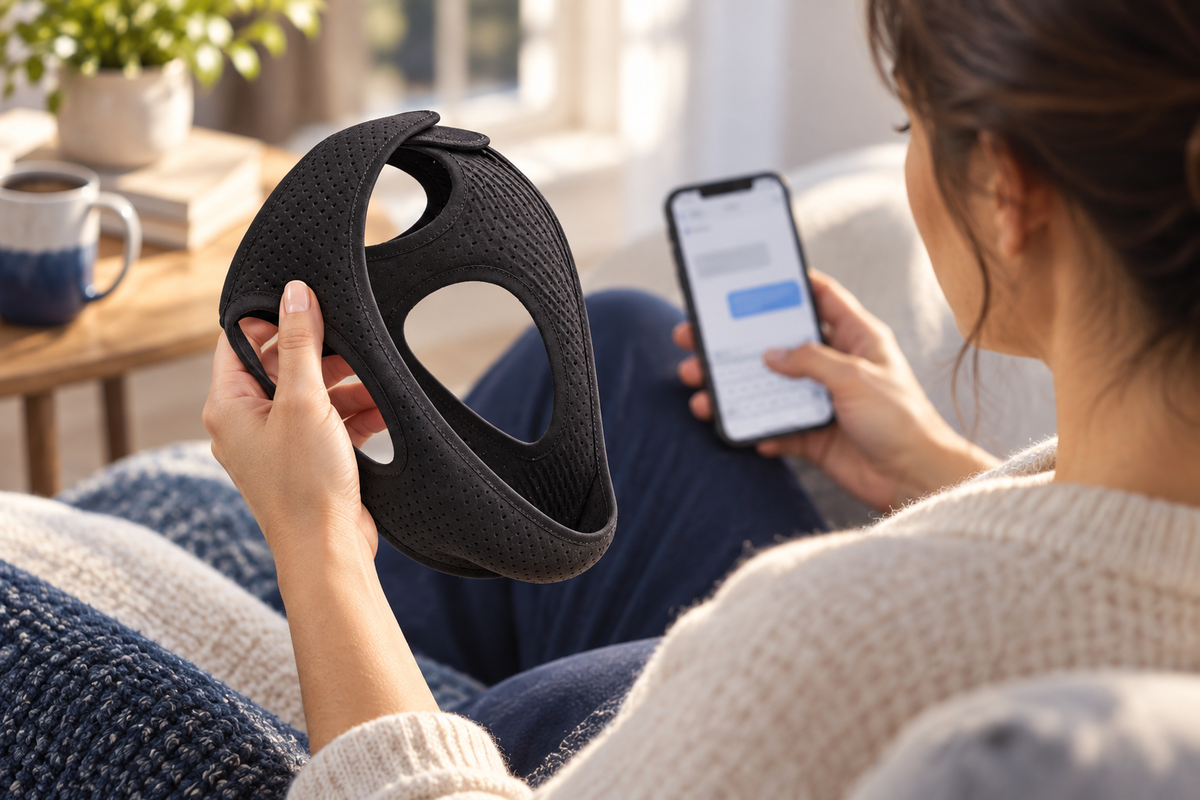
Fit help is most useful when you ask before turning a small problem into repeated uncomfortable wear. You do not need to complete the whole 30 night trial before contacting RestHaven about a setup question.
Pause for a repeated problem
Examples worth describing include an ear opening that keeps pulling, a chin cradle that will not stay comfortably positioned, or a fastening you cannot secure according to the directions. Remove the strap rather than adding tension again and again.
If the product causes pain, irritation, or breathing difficulty, stop using it. A support conversation about product setup is not a substitute for medical advice about symptoms or suitability.
Send the details that help
Use the contact information on the Contact page. Include your order number, the strap or pack you ordered, and a plain description of the problem. Mention whether you have checked the supplied instructions and what small adjustment you tried.
A product photo may help explain a damaged closure or folded seam, but only share images you are comfortable sending. Avoid including payment details or unrelated personal information.
Decide between clarification and a return
Support may be able to explain a product feature you misunderstood. If the fit still does not suit you, ask about returning it within the trial window. The process begins with an email and order verification, followed by a prepaid label or carrier barcode.
You are allowed to decide that an accessory is not right for you. The purpose of the trial is to support that decision, not to make you keep wearing an uncomfortable setup.
Recognize when more adjusting is no longer informative
Consider a fitting session where you have reopened the crown several times but cannot explain what each attempt changed. At that point, another adjustment may add confusion rather than useful information. Take the strap off and identify the one question that remains unresolved.
The question might concern the intended overlap, the meaning of the measurement, or an edge that continues to sit uncomfortably. Each of those can be described without diagnosing the cause yourself. A concise observation gives support a clearer starting point than a long account of repeated tightening.
Do not continue through pain, irritation, breathing difficulty, or persistent uncomfortable pressure. Removing the strap is the appropriate response to an unsuitable sensation, even when the product looks correctly positioned. Appearance should not be used to overrule what the wearer notices.
What is a useful first message?
Include the order number if purchased, name the part involved, and describe what you have already tried according to the instructions. Ask for the clarification you need. Avoid sending payment credentials or a detailed medical history. If the concern is medical suitability, direct that question to an appropriate clinician.
What if the answer is that the design is not right for you?
That is a valid outcome of the trial. You can request a free return within the stated window rather than treating continued adjustment as an obligation. Support can explain the prepaid label or barcode process and help match the return to the order. The purpose of asking for help is to reach a clear next step, including a decision to stop using and return the item.
Prepare a fitting space that makes the details visible
Set the strap on a clear surface beside the instructions supplied with your item. Good lighting is more useful than a complicated setup. You want to see the edges, the openings, and the fastening without turning the first fitting into an event that needs special equipment or a second person.
Start with the product open and relaxed. Follow the fabric from the broad cradle toward each ear opening and then to the crown. If a side panel is folded inside out or crossed over another part, correct the orientation before bringing it to your face. It is easier to understand the shape when nothing is under tension.
Keep anything that might catch in the fastening away from the work area. Loose hair, delicate clothing, and nearby fabric can distract from the fit check. You do not need to change your appearance or buy extra accessories; the aim is simply to notice what is part of the strap and what may be interfering with it.
If the item appears different from the listing, is damaged, or arrives without usable instructions, contact the team before using it. A website photograph is a helpful reference, but it does not replace the directions for the actual item. You can ask a precise question without improvising a fitting method.
Distinguish placement from tension
Placement describes where the product sits. Tension describes how firmly it is fastened. They interact, but they are not the same problem. An ear opening that is out of position may need the strap to be reopened and reset; simply tightening the crown can make the misplaced edge feel worse.
Check the broad chin cradle first, following the supplied directions. Then look at both side panels and the ear openings before assessing the closure. Taking the whole arrangement in sequence is clearer than repeatedly pulling on whichever part first draws your attention.
Use small, deliberate changes. After making one adjustment, check the rest of the fit again. If the fabric has twisted, release it and straighten the arrangement while it is off. Avoid dragging a tightly fastened edge across your face to chase the position shown in a product photograph.
The product should not be treated as something to tighten as far as possible. Support is not a contest of pressure, and the fastening's remaining overlap is not a score. If you cannot find a suitable setup without discomfort, stop and ask for clarification or use the return process.
Make the first check while fully awake
Choose a moment when you can pay attention to the product and remove it easily. The first fitting is for understanding the shape and feel, not for proving that you can tolerate an unfamiliar sensation for a long period. There is no reason to rush straight from opening the parcel to overnight use.
Keep the nose and lips uncovered. Notice whether an edge has rolled inward, whether an ear is being pulled, and whether the chin cradle is where the instructions intend it to sit. A front view and a side view can reveal different details, so do not rely on a single glance.
If you experience pain, irritation, difficulty breathing, or persistent uncomfortable pressure, remove the strap. Do not interpret discomfort as a necessary stage of making the product work. A product trial is a chance to assess suitability; it is not an obligation to continue through a problem.
For medical suitability, questions about a breathing condition, or use alongside prescribed equipment, consult the appropriate clinician. Customer support can clarify the product and its instructions, but a retail conversation cannot establish an individual medical recommendation.
Use a mirror or a partner without losing control of the fit
A mirror is useful for spotting a twist or a trapped strand of hair. It cannot tell you how much pressure you feel. Compare what you see with what you notice physically, and let your own comfort remain part of the decision rather than judging the fit entirely by appearance.
If a partner helps, ask for a description before an adjustment. A sentence such as the left edge looks folded gives you information you can act on. Someone reaching over and tightening the strap without warning gives you less control and can make it harder to understand what changed.
The wearer should decide whether to continue, remove the product, or ask a question. A partner may have useful observations, but their view that the strap looks comfortable does not override the wearer's experience. Keep the fitting cooperative and unhurried.
You do not need to take a personal photograph for an initial check. If you later choose to send an image to support, frame it around the specific product question and avoid including unrelated people or private details in the background. A written description is often enough to begin the conversation.
Understand the limits of the size listing
RestHaven's listing includes a 56 cm measurement. Before comparing that number with a measurement of your head, establish what the listing measures. A product length and a recommended body measurement are different types of information, even when both use centimeters.
Ask support which part of the product the number describes and whether a fit range is provided for your intended comparison. Do not create your own size chart from the model's face or assume that an adjustable closure makes the number irrelevant.
The shape matters alongside any measurement. Ear position, hair, facial proportions, and the way the fabric lies can affect whether a design suits a particular person. Two adults may find different settings comfortable, and a shared purchase does not create a shared fit requirement.
If uncertainty remains, waiting for clarification is a sensible choice. Ordering several straps does not resolve an unclear measurement. Begin with the information you need, then choose the number of items that serves your actual routine.
Keep useful notes without overcomplicating the evening
A short note can help if the same question comes up again. Record the part you were checking, what you changed, and what you noticed afterward. Keep the description practical: an edge remained folded, an opening seemed out of position, or you could not identify the intended fastening overlap.
Change one aspect at a time when following the instructions. If you reposition every part at once, it becomes harder to explain which change helped or which problem remained. You are not conducting a medical experiment; you are making a simple record of a product setup.
Do not use a diary to pressure yourself into continuing with discomfort. A clear note that the fit was unsuitable is as useful as a note that you found the fastening manageable. The goal is a decision you feel comfortable with, not a perfect chart.
Store the note with your order confirmation and product instructions if that is convenient. Keeping those details together can save time when asking support a question. It also helps you find the delivery date if you decide to request a return during the trial.
Ask a question the team can answer clearly
Email support@shopresthaven.com with a focused subject and the order number if you have already purchased. Identify the part of the strap involved. Describe whether the issue concerns the instructions, the visible construction, a measurement, or something that happened during the awake fit check.
Mention the adjustment you already tried, but avoid sending a long sequence of guesses. A concise account of the current issue is easier to understand than several messages that use different words for the same part. If the team asks for clarification, continue in the same conversation.
Do not send passwords, card security codes, or full payment numbers. Those details are unnecessary for a fitting question. Medical concerns belong with a qualified professional, and you do not need to disclose a detailed health history to ask how the crown closure is meant to align.
Support can explain available product information and the return route. It should not be used as a reason to ignore discomfort or to modify the product yourself. Avoid cutting, sewing, or adding another fastening to force a design that does not suit you.
Use the trial as a genuine decision period
RestHaven offers a 30 night trial, with a free return request available within 30 days of delivery. Normal trial use does not by itself make the purchase ineligible. Read the returns page before you need it so that the process is familiar.
If you decide to return, email the team with your order number, checkout email, and the item or pack involved. After verification, the team sends a prepaid return label or carrier barcode and instructions. Wait for those details instead of choosing a return address yourself.
For a complete pack return, include all straps from that pack. For a partial pack return, ask the team to confirm the items and refund amount first. Keep the carrier drop off receipt and tracking reference so that the parcel can be followed through the return process.
The team checks the parcel after it is received and issues the refund for the returned items to the original payment method. Your provider may take additional time to show the credit. The trial gives you room to decide whether this particular design belongs in your routine, including deciding that it does not.
Put the information to work
Choose the one question from this guide that matters most to your situation and write down the next action it calls for. That might mean checking the supplied instructions, reviewing an order detail, asking the team a specific question, or deciding that you need more information before purchasing. You do not need to complete every possible step at once.
Keep the relevant product information and any support reply together so you can find them when needed. Use the current RestHaven product page for the available pack options and prices, and the returns page for the 30 night trial process. The team can be reached at support@shopresthaven.com.
For a related practical question, continue with How to Put On a RestHaven Chin Strap. Each guide can be read independently; use the contents links to return to the section that answers your immediate question.